Collection: Coffee filters

Great coffee is built on details. The filter is one of them — easy to overlook, yet present in every single cup. The right filter, the right cup. Find yours.

  • Coffee filters are an essential part of most brewing methods — from classic automatic drip machines to manual pour over drippers. The right filter traps the grounds and fine coffee particles, producing a clear brew free of unwanted sediment. Beyond clarity, the type of filter you choose has a meaningful impact on flavour, aroma, and body.

  • Types of Coffee Filters and How They Affect Your Cup

    There are three main types of coffee filter: paper, metal, and cloth. Each works differently and produces a noticeably different result in the cup.

  • Paper Filters

    Paper filters are the most widely used option, particularly in pour over and drip brewing. Made from densely woven cellulose, they trap both coffee grounds and the natural oils present in coffee, producing a brew that is exceptionally clean and clear, with a light, delicate body. With the oils removed, brighter and fruitier notes tend to come through more clearly. The tradeoff is a slight reduction in aromatic depth — paper-filtered coffee is often described as clean and crisp, but less full-bodied than other methods.

    Paper filters also capture diterpenes (cafestol and kahweol) — compounds found in coffee oils associated with raising LDL cholesterol levels. For this reason, paper-filtered coffee is generally considered the better choice for those monitoring their cholesterol.

  • Metal Filters

    Metal filters — most commonly stainless steel, though titanium and gold-plated versions also exist — are a reusable alternative to paper. The fine mesh stops larger coffee particles but allows the natural oils and fine micro-grounds to pass through into the cup. The result is a noticeably fuller brew: richer body, more texture, and a heavier feel on the palate — sometimes with a small amount of sediment at the bottom of the cup. Because the oils are present, aromatic intensity is also higher; those compounds carry a wide range of fragrance notes, from floral to nutty. The oils also soften the perception of acidity, making the cup feel rounder overall.

    If you prefer a bold, full-bodied brew with depth and intensity, a metal filter is the better fit.

  • Cloth Filters

    Cloth filters — typically made from cotton or linen — sit between paper and metal in terms of what they let through. The fabric traps most coffee particles, including very fine ones, but only partially absorbs the oils. In practice, cloth-filtered coffee is clean and sediment-free like a paper brew, but retains enough oil to add body and aromatic richness. The result is a cup that is full in flavour and body, yet still clear and transparent — without cloudiness or heaviness. Acidity remains present but is gently balanced by the oils. The exact outcome depends on the specific coffee and the density of the cloth.

  • Everything You Need to Know About Paper Filters

    Paper filters are simple, but a few details are worth understanding — the type of paper (bleached or unbleached) and the filter's construction both have a real effect on the brew.

    Bleached vs. Unbleached Filters

    The colour of a paper filter reflects how it was processed. White bleached filters are treated during production — either with chlorine or by an oxygen-based method. Brown unbleached filters are simply natural paper with no bleaching treatment. The differences are subtle but worth knowing.

    • Effect on flavour. The main advantage of bleached filters is neutrality — they contribute less of a papery taste to the brew, because most of the lignin (the compound that gives paper its natural brown colour and woody smell) has been removed during bleaching.
    • Ecology and production. Unbleached filters are generally considered the more environmentally straightforward option, as their production avoids bleaching chemicals. Bleached filters do require chemical treatment, though many manufacturers use chlorine-free methods. Both white and brown paper filters are compostable.
  • Filter Construction and Its Effect on Flow and Extraction

    Not all paper filters behave the same way. Thickness, density, and surface texture all influence how quickly water passes through the grounds — and flow rate directly affects extraction. An extra half minute before the brew passes through the filter means stronger extraction — a slightly more intense, fuller cup.

    It is also worth knowing that ribbed or textured filters (with embossed grooves) create micro-channels between the filter and the dripper wall, improving airflow and water drainage. These small design details have a real effect on brewing: slower flow means longer contact time between water and coffee, which results in stronger extraction — and vice versa.

  • Filter Construction and Its Effect on Flow and Extraction

    Not all paper filters behave the same way. Thickness, density, and surface texture all influence how quickly water passes through the grounds — and flow rate directly affects extraction. An extra half minute before the brew passes through the filter means stronger extraction — a slightly more intense, fuller cup.

    It is also worth knowing that ribbed or textured filters (with embossed grooves) create micro-channels between the filter and the dripper wall, improving airflow and water drainage. These small design details have a real effect on brewing: slower flow means longer contact time between water and coffee, which results in stronger extraction — and vice versa.

  • Matching Filters to Brewing Methods

    Different brewing methods require different filter types. Here is a practical overview:

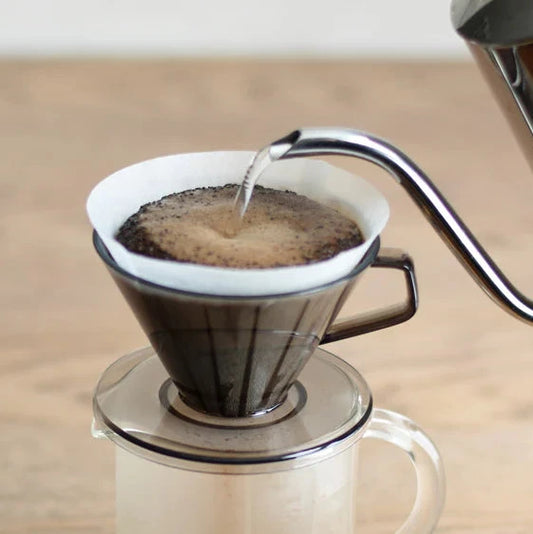
    • Pour over drippers (Hario V60, Chemex, Kalita) — classic pour over methods each use a specific paper filter shape. The V60 takes a thin conical filter (bleached or unbleached); the Kalita Wave uses a flat-bottomed rippled filter; the Chemex requires its own thick conical filter (square or round). All are single-use, though reusable alternatives exist for most.
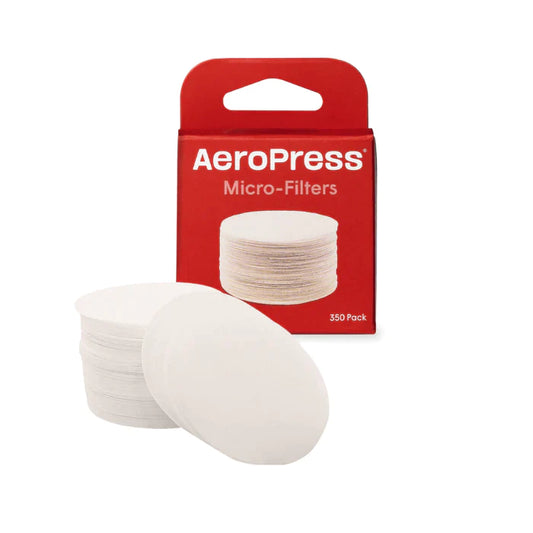
    • AeroPress — designed for small circular paper filters (~6 cm diameter). The filters are thinner than Chemex filters, allowing water to pass through quickly under light pressure in a matter of seconds. Many brewers experiment with metal filters for the AeroPress, which produce a fuller body and more aromatic cup while keeping the short extraction time the method is known for.
    • Automatic drip machines — most use basket-style paper filters in a truncated cone or flat-bottom shape, typically size #2 or #4 depending on machine capacity. Both bleached and unbleached versions are available and fit into the machine's plastic or metal basket.
    • French Press — no separate paper filter is needed. The built-in metal mesh plunger presses the grounds to the bottom and separates them from the brew. The cup has a full body but carries some fine sediment, giving it a heavier, more rustic character. Use a coarse grind to minimise particles passing through the mesh.
    • Cold brew — filtering cold brew concentrate is straightforward using a fine metal sieve, a cloth filter (coffee sock), or a standard paper filter from a drip machine.
    • Drip bag / single-serve filter bags — a convenient format for travel or a busy routine. A drip bag is a single-use filter pre-filled with a portion of ground coffee (~10 g) that unfolds over the rim of a cup. Pour hot water through and brew directly — essentially a miniature dripper, no equipment needed.
  • Practical Tips for Using a Coffee Filter

    • Rinse the filter before use. This removes any paper dust or residual production taste. It also pre-heats the dripper or server, which helps maintain the correct brewing temperature.
    • Choose the right size and shape. Always use a filter designed for your specific brewer. Filters come in different sizes and shapes — one that is too small will overflow with grounds, and a poorly fitting shape will cause leaking. Before brewing, seat the filter correctly: in conical drippers, fold the crimped edges so the filter sits flush against the wall. In drip machines, make sure the filter lies flat in the basket.
    • Match your grind to the filter. Different filters suit different grind sizes. Paper filters generally work best with a medium or medium-fine grind. Metal filters tolerate a slightly finer grind than paper (water passes through larger openings), but grinding too fine will result in significant sediment in the cup.
    • Dispose of or clean the filter after use. Paper filters can go straight into the bin after brewing — ideally into food waste or compost, as they are organic material and most are biodegradable. Metal and cloth filters need immediate attention: discard the grounds (also compostable), then wash the filter thoroughly. Rinse a metal filter under running water and gently scrub with a soft brush and a little washing-up liquid to remove oil residue. A cloth filter should be rinsed very thoroughly in hot water after every use until the water runs clear.

    Choosing a filter comes down to personal preference — each type has its strengths. It is worth trying different options and experimenting. That is how you find what suits your palate best. Whatever you choose, using your filter correctly and keeping it clean will make a real difference in the cup.