If you love matcha but don't own a bamboo whisk, a ceramic bowl or a full ceremonial set yet — don't worry. You don't need any of it to get started. Making matcha well comes down to three things: good-quality tea, water at the right temperature, and a way to mix it thoroughly. That's genuinely all you need to begin. In this guide, we show you how to make matcha at home step by step — the classic way with water, with milk, and iced.
What is matcha, and why does it need whisking?
Matcha is a finely ground powder made from whole green tea leaves — not a tea you steep, but a suspension you drink in its entirety. That's exactly why you can't just pour water over it and wait, the way you would with a regular tea. The powder doesn't dissolve in water — it needs to be emulsified, meaning evenly suspended through the liquid. Without whisking it settles at the bottom, and instead of a creamy drink you're left with green sediment.

It's worth understanding this before reaching for any tool: the goal isn't to "dissolve" matcha, but to create a smooth, even suspension. Different whisking methods give different results — but each one works, as long as you know what you're aiming for.
Read also: What Is Matcha, and Why Is It Worth Drinking? A Guide to Japanese Tea
What you really need to make matcha
The list is shorter than you'd think:
- Good-quality matcha — ceremonial or traditional grade. The quality of the powder shapes the flavour far more than any piece of equipment.
- Water at 70–80°C — not boiling. Water that's too hot destroys the amino acids responsible for matcha's natural sweetness and umami, and brings out bitterness instead.
- Something to whisk with — a chasen, an electric milk frother, a shaker or a small whisk. Details below.
- A vessel — any small bowl, mug or glass works.
Did you know? If you don't have a thermometer, you can estimate water temperature by timing it after boiling — about 3 minutes after boiling, water sits at around 85°C; after 5 minutes, around 80°C. For matcha, the second is the better target.
The chasen whisk – when it's worth it, and when it isn't
The chasen, the traditional bamboo whisk used for matcha, is a tool built for exactly this one task. Its structure — dozens of thin bamboo tines bound together at one end — aerates the matcha as you whisk and builds a light foam on top of the drink. The result is noticeably better than other methods: a smooth emulsion, a creamy texture, and minimal risk of clumps.

If you drink matcha regularly and care about quality, a chasen is worth considering as an investment. A good chasen made from pale bamboo lasts many months with proper care. But if you're just starting out, or only want to make matcha occasionally, it isn't essential — the methods below give genuinely good results too.
If you'd still like to try one, JAVA Coffee carries both a bamboo chasen whisk and a complete starter kit with matcha, whisk and bowl — everything in one place.
What can replace a whisk – what actually works?
Three methods that genuinely work — each with a slightly different result:
Whisk alternatives for matcha
| best result
Electric milk frother The closest alternative to a chasen. Aerates the matcha, builds foam and breaks up clumps in 20–30 seconds. Works in a mug or a bowl. |
good result
Shaker or screw-top jar Great for the iced version — mix matcha with a little lukewarm water, then add cold milk or water and shake vigorously for 15–20 seconds. For a hot version, be careful and keep the lid tightly sealed. |
good result
Mini whisk Works well if you're used to fast whisking. Needs a brisk W- or M-shaped wrist motion, just like a chasen. Less aeration, but still gives a smooth emulsion. |
Not recommended for matcha: ✕ Teaspoon ✕ Fork ✕ Circular stirring
How to make matcha step by step – the classic version
This is the base recipe: matcha with water, no milk. The ratios are tested and repeatable.
Ingredients (1 serving):
- 2 g matcha (about 1 level teaspoon)
- 70–80 ml water (70–80°C)
Method:
- Sift the matcha through a fine sieve into a bowl or mug. This step removes clumps before you even start whisking — skipping it is the most common mistake.
- Add a small amount of water — about 20–30 ml. Not the full amount at once. A small amount first lets you build a paste that's much easier to smooth out afterwards.
- Whisk vigorously with your chosen tool (frother, chasen or whisk) for 20–30 seconds, using a W or M motion — not circular. The matcha should become a uniform, dark green paste with no clumps.
- Add the rest of the water and whisk again for another 15–20 seconds. A light foam should appear on the surface — a sign of a good emulsion.
- Drink straight away. Matcha settles over time — if it's been sitting, a quick re-whisk before drinking restores the texture.
| Parameter | Value | What happens if you miss it |
|---|---|---|
| Amount of matcha | 2 g (1 level teaspoon) | Too little → watery, flavourless. Too much → bitter, harsh. |
| Water temperature | 70–80°C | Boiling → bitterness, damaged amino acids. Too cold → clumps, poor emulsion. |
| Water volume (water version) | 70–80 ml | Too much → diluted, flat. Too little → overly intense, hard to drink. |
| Whisking time | 20–30 seconds | Too short → clumps and an uneven emulsion. |
How to make matcha with milk
Matcha with milk — matcha latte — is the same base recipe, with one difference: instead of the full amount of water, you use a smaller amount to make a concentrate, then top it up to volume with milk.
A matcha latte starts as a matcha concentrate combined with milk, which softens its intensity, adds creaminess, and changes the character of the drink. Both dairy and plant-based milk work — the choice comes down to taste preference and the equipment you have available.
Ingredients (1 serving):
- 2 g matcha (1 level teaspoon)
- 60 ml water (70–80°C)
- 150–180 ml milk — dairy or plant-based
Hot version:
- Sift the matcha, add the water and whisk to a smooth paste — as in the classic recipe.
- Warm the milk to around 60–65°C. If you have a frother, froth it. If not, simply warmed milk works too.
- Pour the milk into the cup with the matcha, or pour the matcha concentrate into the milk — whichever order you prefer. Stir gently.
Cold version (iced matcha latte):
- Sift the matcha, add 60 ml of lukewarm water (around 70°C) and whisk until smooth.
- Fill a tall glass with ice and pour in cold milk.
- Pour the matcha concentrate slowly over the back of a spoon, down the side of the glass, so a clear green layer forms on top. Stir before drinking.
Want to see more variations — coconut, lavender, or a dirty matcha with espresso? Check out Matcha Latte – A Step-by-Step Recipe and the Best Variations, put together by our resident expert.
Which plant milk works best – and why it depends on the method?
Dairy milk works well, but a plant-based matcha latte is now the standard, in cafés and home kitchens alike. The choice of milk does matter in practice, though: without a frother, different plant milks behave quite differently. Some emulsify well on their own, others separate without heating or foaming. It helps to know what you're reaching for.
| Milk | No frother (hot) | In a shaker (cold) | Flavour with matcha | Recommendation |
|---|---|---|---|---|
| Oat (barista) | Very good — creamy, doesn't separate, blends well with matcha even without foaming | Excellent — forms a smooth, lightly foamed emulsion once shaken | Neutral, lightly sweet — doesn't mask the matcha flavour | ✓ Best choice for any method |
| Coconut | Good — its fat content helps the emulsion and it doesn't separate when heated | Good cold, but can separate if the temperature is too low | Distinct coconut flavour — changes the character of the drink into its own variation | ✓ Great if you like a coconut profile |
| Almond | Weaker — low protein content causes separation when heated without a frother | Works well in a shaker — shaking does the job a frother would | Delicate, lightly nutty — pairs well with ceremonial-grade matcha | ✓ Better cold than hot |
| Soy | Good — high protein content gives a stable emulsion even without foaming | Good — mixes well in a shaker, doesn't separate | A distinct flavour that can dominate a subtle matcha — better with traditional or everyday grade matcha | ✓ A solid option, especially hot |
Barista-format plant milk differs from the standard version in its stabiliser and protein content — it's designed for emulsifying and foaming, which is why it performs better without a frother than its regular counterpart. If you have the choice, always go for the barista version. You'll find the full range of plant-based milks for coffee and matcha at JAVA Coffee — Minor Figures oat, Rude Health almond and coconut, and other proven barista brands.
How to make iced matcha
Iced matcha is the simplest version — no heating milk, no foaming, and the result is immediate. The key is the order of ingredients: concentrate first, then ice and milk — not the other way round.

Ingredients (1 serving):
- 2 g matcha
- 60 ml water (70–80°C) — for the concentrate
- 150 ml cold milk or water
- a generous handful of ice
Method:
- Sift the matcha and whisk it with 60 ml of hot water until smooth — with a frother, in a shaker, or with a whisk. This is your concentrate.
- Fill a tall glass with ice, then pour in cold milk or water.
- Slowly pour the matcha concentrate down the side of the glass. The green layer will settle on top of the milk, creating distinct layers — part of the appeal is visual.
- Stir before drinking, or sip through the layers and watch the colours blend.
Shaker tip: If you're using a shaker, prepare the concentrate in a small bowl or mug first, then pour it into the shaker along with the ice and cold milk. Mixing hot matcha with ice directly in the shaker dilutes the concentrate before you've had a chance to whisk it properly.
Common mistakes when making matcha
| Mistake | Effect | Fix |
|---|---|---|
| Boiling water instead of 70–80°C | Bitter, harsh matcha — damaged amino acids (L-theanine) that are responsible for sweetness and umami | Wait 3–5 minutes after boiling, or use a kettle with temperature control |
| Skipping the sieve | Clumps that won't break down even with intensive whisking | Always sift matcha through a fine sieve before adding water |
| Too much water too soon | The powder can't form a paste — harder to emulsify, and clumps remain suspended in a diluted liquid | Add 20–30 ml of water first, build a paste, then top up with the rest |
| Stirring in circles with a spoon | An uneven emulsion with sediment at the bottom | Use a W or M motion, as with a chasen. An electric frother removes this problem entirely |
| Low-quality matcha | A dull yellowish colour, sharp bitterness, flat flavour — regardless of technique | Good technique can't fix a poor powder. Start with ceremonial or traditional-grade matcha from Japanese farms |
Which matcha should you use at home?
Technique matters, but the flavour of the drink starts with the quality of the powder. Even a perfectly prepared culinary-grade matcha will taste bitter and look olive-yellow in the cup — because it comes from a later harvest and is meant for cooking, not drinking.

For drinking with just water, ceremonial or traditional-grade matcha from the first or second harvest is the best choice. It's intensely green, stone-ground to a fine powder, with natural umami sweetness and minimal bitterness. For matcha lattes and milk-based drinks, everyday-grade matcha is a sensible option — the milk balances its bolder character, and it's a more economical choice if you're drinking matcha regularly.
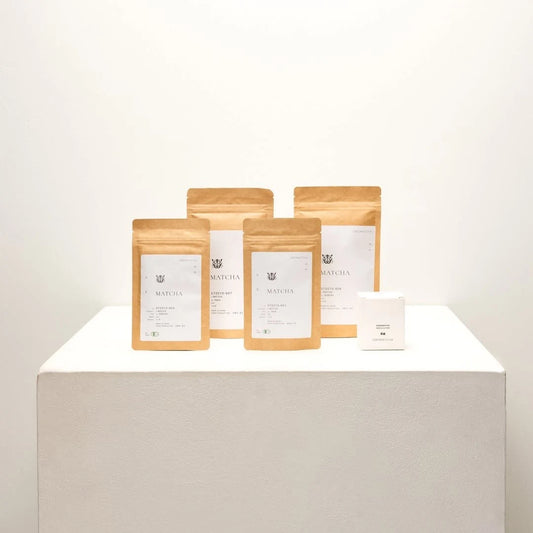
JAVA Coffee carries Moya Everyday Matcha — an organic Japanese matcha at a good price point, equally suited to lattes and the shaker. If you're just starting out and want a complete kit from day one, the Matcha Starter Kit with whisk and bowl is a convenient place to begin.
Wondering how to choose a matcha and what to look for on the label? Check out What Is Matcha, and Why Is It Worth Drinking?, put together by our resident expert.
Frequently asked questions
Can you make matcha with boiling water?
No — boiling water (100°C) destroys the amino acids responsible for matcha's sweetness and umami, particularly L-theanine, and brings out bitterness instead. The ideal temperature is 70–80°C. If you don't have a thermometer, wait 3–5 minutes after boiling.
How much matcha per cup?
A standard serving is 2 g — roughly one level teaspoon. This is the amount used in most clinical studies and ceremonial recipes. For a matcha latte, the amount stays the same — only the ratio of water to milk changes.
How do you avoid clumps in matcha?
Two steps eliminate clumps in almost any situation: sift the matcha through a fine sieve before adding water, and whisk the powder with a small amount of water (20–30 ml) into a paste first, before adding the rest. An electric frother solves the problem mechanically as well.
Does matcha taste different without a whisk?
The flavour is the same — the difference is in texture and foam. A chasen aerates the matcha and creates a characteristic light foam on top that other methods don't quite replicate. An electric frother comes closest. For everyday drinking the difference is minimal; for a ceremonial-style serving, it matters more.
How long can opened matcha be stored?
Opened matcha should be kept in an airtight container, away from light, heat and moisture — ideally in the fridge. Once opened, matcha keeps its full flavour and colour for around 4–6 weeks. Older powder isn't harmful, but it loses some of its vivid green colour and depth of flavour.
Sources
- Kochman J. et al., Health Benefits and Chemical Composition of Matcha Green Tea: A Review, Nutrients, 2021, PMC7796401
- Unno K. et al., Stress-Reducing Function of Matcha Green Tea in Animal Experiments and Clinical Trials, Nutrients, 2018, PMC6213777
- National Center for Nutrition Education (NCEZ/PZH), Is Drinking Matcha a Healthy Trend? (source in Polish), ncez.pzh.gov.pl, 2025
- Maison Koko, Best Milk for Matcha Lattes: Oat, Almond, Soy, Coconut or Dairy?, maisonkoko.com, 2025